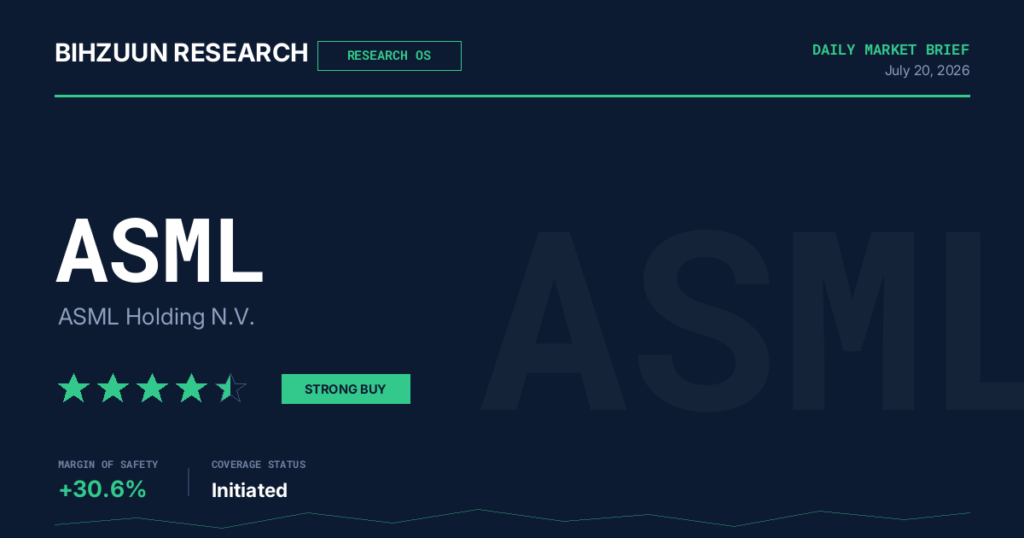
ASML Holding N.V. Institutional Investment Research
1. Summary Table
| Company | Ticker | MRS Rating | Current Reference Price | 12-Month Target | Margin of Safety | Timeframe |
|---|---|---|---|---|---|---|
| ASML Holding N.V. | ASML |
★★★★★ STRONG BUY |
$1,747.58 | $1,446.18 | -17.2% | 12 months |
- Investment thesis: ASML is a systemically important semiconductor-equipment franchise with an exceptionally durable technological moat, outstanding profitability, substantial pricing power and direct exposure to advanced-node and artificial-intelligence infrastructure investment.
- Core tension: the quality of the business is materially stronger than the attractiveness of the current entry price. The shares trade above the composite valuation despite favorable discounted-cash-flow outcomes.
- Institutional interpretation: the MRS rating recognizes ASML’s exceptional strategic and financial quality. The Maivan Research Rating implementation posture is more valuation-sensitive and favors selective accumulation during material pullbacks.
- Confidence level: low to moderate on the 12-month price target because the usable valuation models produce an unusually wide range of outcomes.
2. Business Overview & Economic Moat
- ASML supplies lithography systems used to manufacture advanced and mature semiconductor devices. Its products are mission-critical to customer road maps because lithography determines the ability to print progressively smaller and more complex chip features.
- The company controls the commercial extreme-ultraviolet lithography market and is estimated to hold approximately 92% of the broader lithography market. This market structure gives ASML strategic importance across the global semiconductor supply chain.
- The moat rests on accumulated process knowledge, intellectual property, customer co-development, precision manufacturing, supplier integration and an installed base that would require extraordinary time and capital to replicate.
- Ownership of Cymer and ASML’s strategic relationship with Carl Zeiss SMT reinforce control over critical light-source and optical technologies. These relationships create a tightly integrated production ecosystem rather than a readily substitutable equipment platform.
- Switching costs are substantial. Lithography systems must be integrated with process-control software, masks, materials and customer-specific fab workflows. Substitution would require process requalification, operational disruption and potentially lower manufacturing yields.
- The installed base creates recurring service, maintenance and upgrade revenue. This revenue should moderate—but cannot eliminate—the volatility associated with new-system orders and semiconductor capital-spending cycles.
- High-NA EUV represents the next extension of the moat. Intel’s reported use of High-NA systems in volume production supports technical validation, while broader customer adoption remains important to achieving attractive returns on ASML’s development and capacity investments.
- Supplied Q2 2026 information indicates €9.3 billion of sales, a 54% gross margin and €2.9 billion of net income. Management reportedly raised 2026 revenue guidance to €43–45 billion, reinforcing the near-term earnings outlook.
Strategic Moat Assessment
| Moat Source | Institutional Assessment | Durability |
|---|---|---|
| EUV technology leadership | Commercially unmatched and central to advanced-node manufacturing | Exceptional |
| Intellectual property and process knowledge | Built over decades and difficult to reproduce through capital alone | Exceptional |
| Supplier ecosystem | Deep integration with specialized optics, light-source and precision-component partners | High |
| Customer switching costs | Requalification, yield risk and workflow integration discourage substitution | High |
| Installed-base services | Recurring service and upgrade revenue enhances visibility and customer dependence | High |
| High-NA platform | Potential next-generation standard, subject to customer adoption and economic returns | High but execution-dependent |
3. Financial Deep Dive
| Metric | Reported Value | Institutional Interpretation |
|---|---|---|
| Revenue | $32.667 billion | Large-scale revenue base supported by advanced lithography leadership |
| Net income | $9.609 billion | Exceptional absolute earnings capacity |
| Net margin | Approximately 29.4% | Demonstrates pricing power, product differentiation and operating leverage |
| Reported growth | 16.4% | Strong expansion, although persistence cannot be established from a single period |
| Return on equity | 49.0% | Highly productive use of shareholder capital |
| Shareholders’ equity | $19.604 billion | Consistent with reported earnings and return on equity |
| Long-term debt | $2.708 billion | Modest relative to equity and annual earnings |
| Long-term debt ratio | 12.1% | Supports a conservative balance-sheet assessment |
| Dividend payout ratio | 35.5% | Leaves substantial earnings available for reinvestment |
| Dividend yield | 0.50% | ASML is a compounding and growth investment rather than an income security |
| Earnings per share | $24.73 | Supports a manageable dividend payout but also indicates a demanding market valuation |
Financial Quality Assessment
| MRS Component | Score | Assessment |
|---|---|---|
| Financial Quality | 100 | Exceptional profitability and capital productivity |
| Growth | 100 | Strong reported expansion, subject to semiconductor-cycle normalization |
| Balance Sheet | 85 | Conservative leverage, with incomplete liquidity and maturity information |
| Income | 13 | Low yield and a reinvestment-oriented capital-allocation profile |
| Valuation | 0 | Current price exceeds composite intrinsic value and offers no valuation buffer |
| Composite | 63.9/100 | Elite business quality offset by a demanding entry valuation |
- The net margin and return on equity are consistent with an economic franchise possessing scarcity value and pricing power. However, the supplied financial data cover only one period and do not establish whether revenue growth, margins or capital returns are improving, stable or normalizing.
- Long-term debt equals approximately 28% of annual net income, indicating substantial debt-service capacity. A complete credit assessment would still require interest expense, liquidity, lease obligations and debt-maturity information.
- Free-cash-flow quality cannot be independently verified from the supplied data. Operating cash flow, capital expenditures, working-capital movements and stock-based compensation were not provided.
- The earnings-to-cash-conversion gap is especially relevant because capacity expansion, supplier commitments and working-capital requirements can cause cash generation to diverge from accounting earnings.
- The 35.5% payout ratio is financially manageable, but the 0.50% dividend yield means shareholder returns will depend primarily on earnings growth and terminal valuation rather than current income.
4. Multi-Model Valuation Assessment
| Valuation Method | Implied Value per Share | Upside or Downside to $1,747.58 | Assessment |
|---|---|---|---|
| DCF Declining Growth | $2,282.52 | +30.6% | Supports upside but is highly dependent on growth persistence, cash conversion and discount-rate assumptions |
| DCF Bear Case | $2,160.17 | +23.6% | Still above market price, illustrating the DCF’s sensitivity to a strong long-term franchise assumption |
| DCF Bull Case | $2,409.56 | +37.9% | Requires sustained advanced-node demand and successful capacity execution |
| Comparable Companies | $609.84 | -65.1% | Highlights the premium embedded in ASML’s market valuation relative to conventional peer benchmarks |
| Composite Valuation | $1,446.18 | -17.2% | Selected as the 12-month target, with low confidence due to extreme model dispersion |
- The valuation range is unusually wide, reflecting the difficulty of valuing a near-monopoly franchise whose long-duration growth prospects differ materially from those of conventional semiconductor-equipment peers.
- The discounted-cash-flow model assigns considerable value to durable growth, high margins and long-term cash generation. Even modest changes to the discount rate, terminal assumptions or cash conversion could materially change the result.
- The comparable-company result may understate ASML’s strategic scarcity and superior moat, but it remains an important warning that the market is already capitalizing a substantial portion of expected AI and advanced-node growth.
- The dividend-discount model is unstable because the supplied growth assumption exceeds the discount rate. It is therefore not suitable as a primary valuation anchor.
- The Graham Number is not well suited to a high-return, asset-light intellectual-property franchise, while earnings-power value is overly punitive when it assumes no growth for a company currently reporting 16.4% expansion.
- The composite target of $1,446.18 is preferred as a risk-balancing reference rather than a precise estimate of intrinsic value. It implies valuation compression over 12 months despite a favorable long-term business outlook.
Valuation Scenario Framework
| Scenario | Primary Conditions | Likely Valuation Effect |
|---|---|---|
| Bull | AI capital spending remains elevated, High-NA adoption broadens, capacity additions ship profitably and cash conversion remains strong | DCF-led upside toward the upper valuation range |
| Base | Growth remains healthy but moderates, service revenue provides resilience and valuation multiples normalize | Convergence toward the $1,446 composite target |
| Bear | Order delays, China restrictions, customer-capex moderation or execution problems reduce growth and trigger multiple compression | Material downside, potentially moving valuation closer to peer-based outcomes |
5. Competitive & Industry Analysis
| Competitive Force | Current Position | Implication for ASML |
|---|---|---|
| Nikon | Seeking DUV share through lower pricing | Potential pressure on mature-node pricing and margins, but no immediate challenge to EUV leadership |
| Canon | Developing nanoimprint lithography for selected applications | Potential niche alternative with uncertain scalability, yield performance and customer acceptance |
| Chinese domestic development | Reported EUV prototype remains short of high-volume manufacturing readiness | Material long-duration risk, but large-scale replacement of ASML appears unlikely before 2030 based on supplied analysis |
| Customer bargaining power | Customer base is concentrated among leading global chip manufacturers | Concentration raises order volatility, although technical dependence limits substitution leverage |
| Supplier bargaining power | Critical components come from specialized, difficult-to-replace suppliers | Supports the moat while creating production bottleneck and execution risks |
| Semiconductor cycle | Advanced-node demand is strong, while mature-node demand can be more cyclical | EUV resilience may coexist with weaker DUV utilization and customer inventory corrections |
- ASML’s competitive advantage is not merely market share; it is the ability to coordinate a complex innovation network that competitors would need to reproduce simultaneously across optics, light sources, software, metrology, precision manufacturing and customer qualification.
- Competition is most credible at the edges of the portfolio. Lower-priced DUV systems and alternative patterning technologies may affect selected mature-node or specialized applications without displacing ASML’s EUV position.
- China represents both a near-term revenue source and a strategic risk. ASML expects China to account for approximately 20% of 2026 revenue, making further export or servicing restrictions financially meaningful.
- Capacity expansion is supported by reported bookings of nearly all expanded EUV capacity through 2027. Nevertheless, bookings do not eliminate the risks of customer deferrals, supplier delays, quality issues or unfavorable product mix.
- The concentration of demand among TSMC, Samsung, Intel, SK Hynix and Micron creates material exposure to a small number of capital-allocation decisions. ASML’s technological leverage reduces customer substitution risk but not semiconductor-cycle risk.
6. Risk Mapping
| Risk | Probability | Potential Impact | Monitoring Indicators |
|---|---|---|---|
| Valuation compression | High | High | Forward earnings multiple, real yields, AI-capex expectations and order timing |
| Growth deceleration | Medium | High | Bookings, backlog conversion, customer fab schedules and management guidance |
| China export and servicing restrictions | Medium to high | High | U.S. and European policy changes, license approvals and China revenue mix |
| Customer concentration | High | Medium to high | Capital-spending plans from TSMC, Samsung, Intel, SK Hynix and Micron |
| Capacity-expansion execution | Medium | High | Supplier readiness, hiring, system acceptance, gross margin and shipment cadence |
| High-NA adoption delays | Medium | Medium to high | Customer qualifications, production utilization and economics versus alternative process flows |
| Earnings-to-cash-flow gap | Unverified | Medium | Operating cash flow, capital expenditures, working capital and customer deposits |
| DUV price competition | Medium | Medium | Nikon pricing, mature-node demand, system mix and DUV gross margin |
| Domestic Chinese substitution | Low near term; rising long term | High | Prototype performance, yield, throughput, domestic supplier progress and fab qualification |
| Interest-rate sensitivity | Medium | Medium to high | Real yields, inflation releases and central-bank policy expectations |
- The dominant near-term risk is valuation rather than franchise impairment. A high-30s forward multiple leaves limited tolerance for delayed orders, weaker customer capital spending or modest earnings disappointments.
- The shares reportedly appreciated approximately 60% during 2026 and approached a $700 billion market capitalization. Such momentum can persist, but it increases the probability that future operating success has already been capitalized into the price.
- Geopolitical restrictions could affect both new-system sales and the ability to service installed equipment. Service restrictions would have implications for recurring revenue and customer relationships beyond the immediate loss of system shipments.
- Expanding EUV and DUV capacity by nearly one-third annually introduces supplier, labor, quality-control and fixed-cost absorption risks. The same investment that enables upside can magnify downside if customer schedules change.
- Portfolio construction should reflect the asymmetry between business quality and entry valuation. Position sizing, staged purchases and pullback-based accumulation are more appropriate than valuation-insensitive buying.
7. Catalyst Monitor
| Timing | Catalyst | Relevance to ASML |
|---|---|---|
| July 22 | Alphabet earnings | AI infrastructure and capital-spending commentary will test the durability of advanced-node demand |
| July 22 | Texas Instruments earnings | Inventory and manufacturing commentary will provide a read on mature-node demand and DUV utilization |
| July 29 | FOMC decision | Changes in rate expectations could materially affect ASML’s premium valuation multiple |
| July 30 | GDP release | Provides a broader cyclical signal for industrial and semiconductor demand |
| August 1 | Texas Instruments CFO transition | Potential indicator of manufacturing-capex discipline and mature-node investment priorities |
| August 7 | Employment report | Could alter rate expectations and long-duration equity valuations |
| August 12 | CPI release | Inflation data may influence discount rates and technology-sector multiples |
| August 12 | Google hardware event | Lower-order signal for device demand and semiconductor content growth |
| Next operating update | Execution against Q3 guidance of €11–12 billion | Tests backlog conversion, shipment cadence and capacity-expansion execution |
| Ongoing | Additional High-NA qualifications | Would strengthen confidence in the next-generation platform and long-term moat |
| Ongoing | Pricing and product-mix improvement | Could support margins and offset cost inflation or DUV pricing pressure |
- The listed event dates are drawn from the supplied specialist inputs and should be verified against the current corporate and economic calendar before implementation.
- Near-term macroeconomic releases may move ASML’s valuation multiple more than its immediate operating fundamentals because a significant portion of intrinsic value depends on long-duration growth.
- The most important fundamental catalyst is evidence that capacity expansion converts into accepted systems, profitable revenue and cash flow without compromising quality.
- A broadening equity-market regime does not invalidate ASML’s long-term thesis, but historical rotations demonstrate that premium technology leaders can experience sharp corrections even when the wider bull market remains intact.
8. Investment Verdict
| Measure | Conclusion |
|---|---|
| MRS Rating |
★★★★★ STRONG BUY |
| Maivan Research Rating Posture | Hold existing positions; selectively buy on material pullbacks |
| 12-Month Target | $1,446.18 |
| Target Confidence | Low to moderate |
| Long-Term Franchise View | Exceptional |
| Current Entry-Price View | Unattractive without a wider valuation buffer |
- ASML is one of the highest-quality strategic assets in the global technology sector. Its EUV leadership, customer integration, intellectual property, installed-base economics and supplier network support a long runway of attractive earnings power.
- The MRS rating reflects this exceptional franchise quality and the durability of ASML’s competitive position. It should not be interpreted as a recommendation to disregard price or portfolio risk.
- The negative 17.2% margin of safety and wide valuation dispersion prevent an unconditional near-term accumulation stance. The current quotation embeds substantial confidence in AI-led capital spending, High-NA adoption and successful capacity execution.
- The appropriate MRR posture is to retain strategic exposure while reserving incremental capital for material pullbacks, improved cash-flow evidence or upward revisions to independently supportable intrinsic value.
- Upside would require sustained AI infrastructure investment, successful High-NA commercialization, profitable backlog conversion and continued pricing power. Downside could emerge from geopolitical restrictions, customer-capex delays, weaker cash conversion or multiple compression.
- Final institutional view: exceptional company, demanding security price. Long-duration investors should prioritize disciplined entry points and position sizing rather than treating moat quality as protection against valuation risk.
Maivan Academy Disclaimer
- This report is provided by Maivan Academy for educational and informational purposes only. It does not constitute investment advice, an offer, a solicitation, or a recommendation to buy, sell or hold any security.
- All financial figures, market prices, company guidance, event dates and third-party observations are based on the supplied specialist inputs and may be incomplete, future-dated, denominated in different currencies or subject to revision. Investors should verify all information independently.
- Valuation estimates are inherently uncertain and depend on assumptions concerning growth, margins, discount rates, cash conversion, terminal value and market conditions. Actual outcomes may differ materially.
- MRS ratings express a research assessment of investment quality and prospective attractiveness. The MRR posture reflects implementation considerations, including valuation, timing and risk. Neither guarantees future performance.
- Investors should consider their objectives, financial circumstances, tax position, liquidity requirements and risk tolerance, and should consult an appropriately licensed financial professional before making investment decisions.