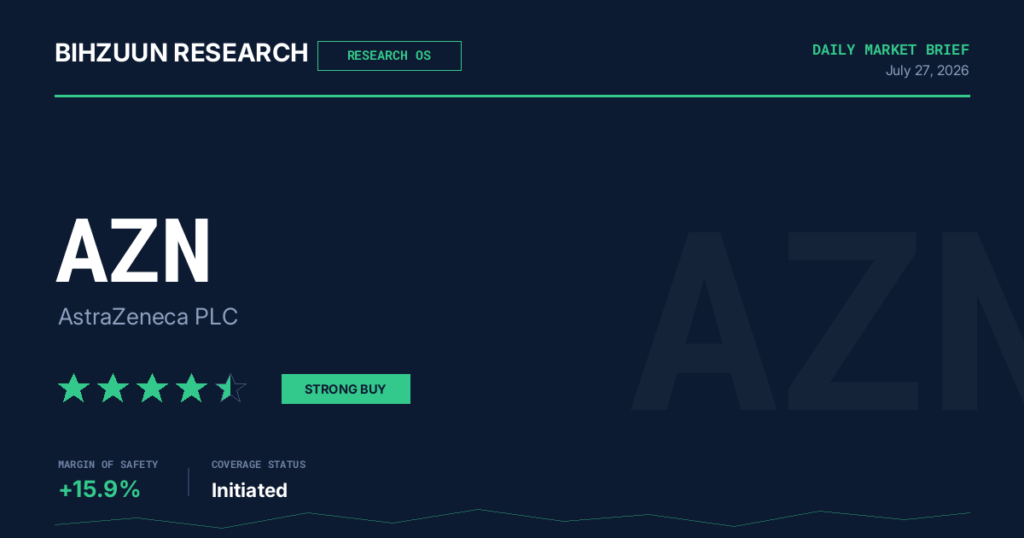
Maivan Academy Research — AstraZeneca PLC (AZN)
1. Investment Summary
| Ticker | Current Reference Price | Maivan Research Score (MRS) | Official 12-Month Target | Official Margin of Safety | Timeframe |
|---|---|---|---|---|---|
| AZN | $169.26 |
★★★★★ Strong Buy |
$196.17 | +15.9% | 12 months |
| Investment Attribute | Institutional Assessment |
|---|---|
| Core Thesis | AstraZeneca combines global pharmaceutical scale, a durable oncology and rare-disease franchise, strong reinvestment capacity, and a pipeline capable of supporting above-industry growth. The valuation case is constructive, although future returns remain sensitive to clinical execution, commercial uptake, patent durability, and cash conversion. |
| Primary Strength | Therapeutic leadership across oncology and rare disease, reinforced by biologics manufacturing, regulatory expertise, extensive clinical datasets, global commercialization infrastructure, and partnership access to antibody-drug conjugate technology. |
| Primary Constraint | The investment case assigns meaningful value to products and indications still subject to binary clinical, regulatory, reimbursement, and launch risks. Balance-sheet strength is adequate rather than exceptional, while cash-flow detail is insufficient for a definitive conversion assessment. |
| Portfolio Role | High-quality healthcare growth exposure for investors able to tolerate drug-development volatility. Position accumulation is preferable during market or readout-driven weakness rather than after sharp momentum advances. |
2. Business Overview & Economic Moat
| Moat Component | Assessment | Investment Relevance |
|---|---|---|
| Therapeutic Leadership | Tagrisso is foundational in EGFR-mutated lung cancer; Enhertu is a leading HER2-directed antibody-drug conjugate; Calquence is strongly positioned in first-line chronic lymphocytic leukemia; and Ultomiris extends the complement franchise through longer dosing intervals. | Established franchises generate commercial leverage, physician familiarity, real-world evidence, and funding for continued pipeline investment. |
| Research and Clinical Scale | AstraZeneca operates a broad development engine spanning oncology, rare disease, cardiovascular, renal, metabolic, respiratory, and immunology indications. | Pipeline breadth reduces dependence on any single development program, although multiple important readouts still create periods of concentrated binary risk. |
| Regulatory and Commercial Infrastructure | Global regulatory capabilities, specialist sales forces, payer relationships, and launch experience create barriers that smaller biotechnology competitors cannot readily replicate. | Scale can accelerate indication expansion and commercialization, but reimbursement pressure may limit the economics of expensive combination regimens. |
| Manufacturing Complexity | Biologics and advanced oncology manufacturing require specialized facilities, quality systems, supply-chain control, and significant capital investment. | Manufacturing expertise supports reliability and creates an operational barrier to entry, while also increasing execution and compliance requirements. |
| Strategic Partnerships | The Daiichi Sankyo relationship provides access to differentiated antibody-drug conjugate technology and has strengthened AstraZeneca’s oncology position. | The partnership expands opportunity but introduces strategic dependency and profit-sharing, reducing the economics relative to wholly owned assets. |
| Moat Conclusion | Wide and durable, but not immune to therapeutic substitution, patent litigation, adverse clinical data, or payer intervention. | The moat supports premium-quality status; continued evidence generation and successful lifecycle management are necessary to preserve that premium. |
- H1 revenue increased 6% at constant exchange rates, with double-digit Oncology and Rare Disease growth offsetting pressure from Farxiga’s US loss of exclusivity and Chinese procurement conditions.
- Management’s long-range ambition of $80 billion in 2030 revenue depends on sustained franchise expansion and successful contributions from newer assets, including Datroway, camizestrant/Etcamah, Baxfendy, tozorakimab, and next-generation oncology combinations.
- AstraZeneca has also initiated six Phase III studies of oral GLP-1 candidate elecoglipron. This creates optionality in obesity and metabolic disease, but differentiation will be essential against entrenched leaders.
3. Financial Deep Dive
| Financial Measure | Reported Figure | Institutional Interpretation |
|---|---|---|
| Revenue | $58,739 million | Substantial global scale, though the supplied data represent a current-period snapshot and do not establish a full historical growth trajectory. |
| Net Income | $10,255 million | Supports a healthy profitability profile and meaningful internal funding capacity. |
| Implied Net Margin | Approximately 17.5% | A strong margin level, but prior-year data are required to determine whether profitability is expanding, stable, or normalizing. |
| Earnings per Share | $13.20 | Provides adequate dividend coverage and a meaningful earnings base for reinvestment. |
| Return on Equity | 21.1% | Indicates efficient deployment of shareholder capital, subject to the influence of leverage and acquisition accounting. |
| Shareholders’ Equity | $48,667 million | Provides a substantial capital base against which current earnings produce an attractive return. |
| Long-Term Debt | $24,715 million | Equivalent to approximately 50.8% of equity. Leverage appears manageable but cannot be fully underwritten without EBITDA, interest coverage, maturity, and free-cash-flow detail. |
| Long-Term Debt Ratio | 33.7% | Consistent with an adequate rather than exceptionally conservative balance sheet. |
| Payout Ratio | 24.2% | Leaves roughly three-quarters of earnings available for research, acquisitions, debt reduction, and other corporate priorities. |
| Dividend Yield | 1.89% | Provides modest income, but income generation is secondary to the growth and pipeline thesis. |
| Implied Dividend per Share | Approximately $3.19 | Broadly consistent with the reported yield at the current reference price and suggests comfortable earnings coverage. |
| Analytical Dimension | Assessment |
|---|---|
| Profitability | Strong. Net margin and ROE support the Financial Quality score of 84/100, although historical comparisons are unavailable. |
| Cash Conversion | Unresolved. Operating cash flow, capital expenditure, working-capital movements, and noncash adjustments were not supplied. Reported earnings quality should therefore be validated against future cash-flow disclosures. |
| Balance Sheet | Adequate. The Balance Sheet score of 58/100 appropriately reflects manageable leverage alongside incomplete debt-service and maturity information. |
| Capital Allocation | Reinvestment-oriented. The low payout ratio preserves flexibility, but shareholder value creation depends on clinical productivity and disciplined deployment of retained earnings. |
| Income Profile | Secondary. The Income score of 47/100 confirms that the dividend is supportive rather than central to the thesis. |
| Growth Profile | High potential. The Growth score of 99 reflects pipeline breadth and therapeutic momentum, but also increases sensitivity to failed trials, delayed approvals, and weaker-than-expected launches. |
4. Multi-Model Valuation Assessment
| Valuation Method | Indicated Value | Assessment |
|---|---|---|
| Declining-Growth Discounted Cash Flow | $196.17 | A constructive intrinsic-value indication that coincides with the official screened target. Its reliability remains dependent on long-range growth, margin, reinvestment, and discount-rate assumptions. |
| Comparable-Company Model | $194.61 | Closely aligned with the DCF and supportive of a valuation in the mid-$190s, subject to changes in sector multiples and the market’s treatment of pipeline quality. |
| Earnings Power Value | $165.00 | Slightly below the current reference price, suggesting that investors must assign value to growth, pipeline conversion, or future margin development rather than rely solely on normalized current earnings power. |
| Graham Number | $136.40 | A materially more conservative asset-and-earnings-based result. This framework generally assigns limited value to intangible research assets and may understate the economics of a research-intensive pharmaceutical platform. |
| Gordon Dividend Discount Model | $2,052.44 | An extreme outlier that should receive little weight. The result illustrates the instability of perpetual-growth models when the discount rate and assumed growth rate are too close. |
| Composite Median Valuation | $194.61 | Informational model composite only. It diverges from the official screened 12-month target of $196.17 and must not be interpreted as the report’s headline target. |
| Sensitivity Case | Indicated Value | Interpretation |
|---|---|---|
| Bear Case | $185.24 | Still above the current reference price, but the model result should not be treated as protection against adverse clinical, regulatory, or market developments. |
| Base Case | $196.17 | Consistent with the official screened target and assumes continued franchise execution without requiring the most optimistic pipeline outcome. |
| Bull Case | $207.55 | Requires stronger pipeline conversion, commercial uptake, or valuation support. |
- Model dispersion is genuine and economically meaningful: conservative earnings and asset frameworks imply limited or negative upside, while growth-sensitive approaches support values in the mid-$190s or higher.
- The valuation thesis therefore rests on AstraZeneca’s ability to convert research spending and retained earnings into durable, cash-generative products.
- The official screened target is $196.17. The separate composite valuation row is analytical context, not a replacement target.
5. Competitive & Industry Analysis
| Market | Competitive Set | AstraZeneca Position | Key Strategic Issue |
|---|---|---|---|
| Solid-Tumor Oncology | Merck, Bristol Myers Squibb, Roche, Johnson & Johnson, Daiichi Sankyo | Strong position through Tagrisso, Imfinzi, Enhertu, Datroway, and a broad combination-development strategy. | Maintaining differentiation as treatment standards evolve and combination regimens become more crowded and expensive. |
| Hematologic Oncology | AbbVie, Johnson & Johnson, other targeted-therapy developers | Calquence is strongly positioned in first-line chronic lymphocytic leukemia. | Competitive sequencing, duration of therapy, safety differentiation, and payer access. |
| Rare Disease | Novartis, Alnylam, Pfizer, BridgeBio, specialist biotechnology companies | The Alexion platform and Ultomiris provide a durable base in complement-mediated disease. | Indication expansion must offset competition, trial failures, and the narrower patient populations typical of rare disease. |
| Respiratory and Immunology | GSK, Sanofi/Regeneron, Amgen | Global capabilities and biologics expertise offer scale, but competition is intense. | Clinical differentiation and access are essential in increasingly segmented biologic markets. |
| Obesity and Metabolic Disease | Eli Lilly, Novo Nordisk, emerging oral and combination developers | Elecoglipron creates long-duration optionality but remains behind established category leaders. | Commercial relevance will require clear differentiation in efficacy, tolerability, convenience, combination use, or cost. |
| China | Multinational and domestic pharmaceutical manufacturers | China remains strategically important but commercially volatile. | Volume-based procurement, pricing pressure, compliance exposure, and a reported 13% Q2 revenue decline make China an active earnings risk. |
6. Risk Mapping
| Risk | Probability | Potential Impact | Institutional Monitoring Framework |
|---|---|---|---|
| Pipeline and Clinical Execution | High | High | Track pivotal readouts, safety signals, enrollment progress, regulatory interactions, and whether positive trials translate into commercially meaningful labels. |
| Evidence of Recent Trial Failures | Realized | Moderate to High | Wainua failed CARDIO-TTRansform, Ultomiris missed in HSCT-TMA, and Imfinzi failed in adjuvant liver cancer. These outcomes demonstrate that pipeline breadth does not eliminate asset-level binary risk. |
| Commercial Launch Risk | Medium | High | Monitor prescriptions, market share, reimbursement, duration of therapy, inventory, geographic rollout, and management’s sales disclosures for Baxfendy, Datroway, Enhertu, and Etcamah. |
| Patent and Exclusivity Risk | Medium | High | Track Tagrisso patent challenges, lifecycle-management progress, indication expansion, and the rate at which newer products offset Farxiga-related pressure. |
| Drug Pricing and Reimbursement | High | High | Assess Medicare-negotiated Farxiga pricing effective in 2026, broader US policy changes, payer resistance to oncology combinations, and international reference-pricing developments. |
| China Pricing and Compliance | High | Moderate to High | Monitor quarterly China revenue, procurement decisions, pricing, compliance disclosures, and management’s ability to offset regional weakness through other markets. |
| Cash Conversion | Medium | Moderate | Reconcile net income with operating cash flow and free cash flow; review working capital, milestone payments, restructuring, capital expenditure, and acquisition-related outflows. |
| Leverage and Refinancing | Medium | Moderate | Review net debt, interest coverage, maturity ladders, refinancing rates, credit ratings, and free-cash-flow coverage as disclosures become available. |
| Partnership Dependence | Medium | Moderate | Evaluate Daiichi Sankyo program economics, profit sharing, governance, manufacturing responsibilities, and the strategic concentration of antibody-drug conjugate development. |
| Foreign Exchange and Macro Volatility | High | Moderate | Track sterling, euro, dollar, yen, and emerging-market currency movements together with interest-rate expectations and translation effects. |
| Valuation Compression | Medium | Moderate to High | A premium growth valuation could contract if readouts disappoint, launches underperform, bond yields rise, or healthcare capital rotates toward lower-multiple alternatives. |
7. Catalyst Monitor
| Catalyst | Expected Relevance | What the Market Will Evaluate |
|---|---|---|
| AVANZAR | Near-term oncology readout | Clinical efficacy, safety, competitive differentiation, addressable population, and potential positioning within lung-cancer treatment pathways. |
| TROPION-Lung07 and TROPION-Lung15 | Near-term oncology readouts | Evidence supporting Datroway’s role, label expansion, sequencing, and the commercial durability of AstraZeneca’s antibody-drug conjugate strategy. |
| PACIFIC-9 | Near-term oncology readout | Potential enhancement of AstraZeneca’s established lung-cancer franchise and the incremental value of combination treatment. |
| SAFFRON | Near-term oncology readout | Strength of efficacy, tolerability, regulatory relevance, and competitive positioning. |
| SERENA-4 | Near-term breast-cancer readout | Potential role of camizestrant-based treatment and whether data support a meaningful new growth platform. |
| VOLGA and NILE | Positive evidence already reported | Regulatory conversion, label breadth, guideline adoption, and bladder-cancer commercial uptake. |
| CLARITY-Gastric01 | Positive trial evidence | Regulatory timing and the commercial significance of the addressable gastric-cancer population. |
| Recent Product Uptake | Quarterly | Launch performance for Baxfendy, Datroway, Enhertu, and Etcamah, including market share and reimbursement progress. |
| 2030 Revenue Ambition | Long term | Progress toward $80 billion in revenue and the contribution expected from more than 20 high-value readouts over the stated 18-month period. |
| Quarterly Financial Execution | Quarterly | Following Q2 revenue of $15.38 billion and core EPS of $2.63, investors will test whether mid-to-high-single-digit revenue growth and low-double-digit core-EPS growth guidance remains credible. |
| Macro Calendar | Short term | FOMC, GDP, employment, CPI, and FOMC-minutes releases can overwhelm company-specific momentum through discount-rate, currency, and risk-appetite channels. Exact event dates should be reconfirmed against the current market calendar. |
- Positive data are not sufficient by themselves; the highest-quality catalysts are those that improve approval probability, broaden labels, strengthen reimbursement, and create measurable revenue acceleration.
- The neutral, selective-rotation environment is broadly compatible with resilient healthcare earnings, but AstraZeneca lacks the immediate cyclical tailwinds available to certain Energy, Utilities, and Industrials exposures.
- Macro announcements can temporarily dominate company fundamentals. Staged accumulation is preferable around closely clustered clinical and economic events.
8. Investment Verdict
| Verdict Measure | Final Assessment |
|---|---|
| Maivan Research Score (MRS) |
★★★★★ Strong Buy |
| Maivan Research Rating (MRR) Posture | Strong Buy — Accumulate on Weakness |
| Current Reference Price | $169.26 |
| Official 12-Month Target | $196.17 |
| Official Margin of Safety | +15.9% |
| Time Horizon | 12 months |
| Confidence | Moderate. Central valuation models align near the official target, but wide model dispersion, incomplete cash-flow evidence, pipeline binary risk, and only moderate balance-sheet strength limit conviction. |
| Final Institutional View | AstraZeneca offers an attractive combination of franchise durability, high-quality therapeutic assets, global scale, and substantial pipeline optionality. Strong profitability and a conservative payout ratio support reinvestment, while the official screened target indicates a favorable return profile. The principal underwriting question is whether pipeline and commercial execution can convert accounting earnings and research intensity into durable free cash flow. The preferred implementation is disciplined accumulation during market, macro, or readout-driven weakness rather than momentum chasing. |
Key Conditions for Thesis Confirmation
- Continued double-digit momentum in strategically important Oncology and Rare Disease franchises.
- Successful regulatory and commercial conversion of positive clinical readouts.
- Evidence that newer launches can offset Farxiga exclusivity pressure and regional weakness in China.
- Improved disclosure and demonstrated consistency in operating cash flow and free-cash-flow conversion.
- Stable leverage, manageable refinancing costs, and continued dividend coverage.
Key Conditions for Thesis Reassessment
- Multiple pivotal trial failures affecting major elements of the long-range growth plan.
- Material erosion of Tagrisso, Enhertu, Calquence, or Ultomiris economics beyond current expectations.
- Persistent China deterioration, expanded pricing intervention, or significant compliance disruption.
- Weak launch adoption for Datroway, Baxfendy, Etcamah, or other products expected to support the 2030 ambition.
- Material deterioration in cash conversion, leverage, interest coverage, or credit quality.
Maivan Academy Disclaimer
- This report is provided solely for educational and informational purposes and does not constitute investment advice, an offer, a solicitation, or a recommendation to buy or sell any security.
- Maivan Research Score ratings, Maivan Research Rating postures, target prices, scenario values, and margin-of-safety figures are research opinions based on supplied information and assumptions. They are not guarantees of future performance.
- Pharmaceutical investments involve material clinical, regulatory, patent, reimbursement, product-liability, currency, and commercialization risks. Actual outcomes may differ substantially from modeled expectations.
- Financial figures may reflect different reporting periods, accounting conventions, exchange rates, or adjusted measures. Investors should verify all information against AstraZeneca’s regulatory filings and current market disclosures.
- Investors should conduct independent due diligence and consider their objectives, time horizon, liquidity needs, tax circumstances, and risk tolerance before making an investment decision.